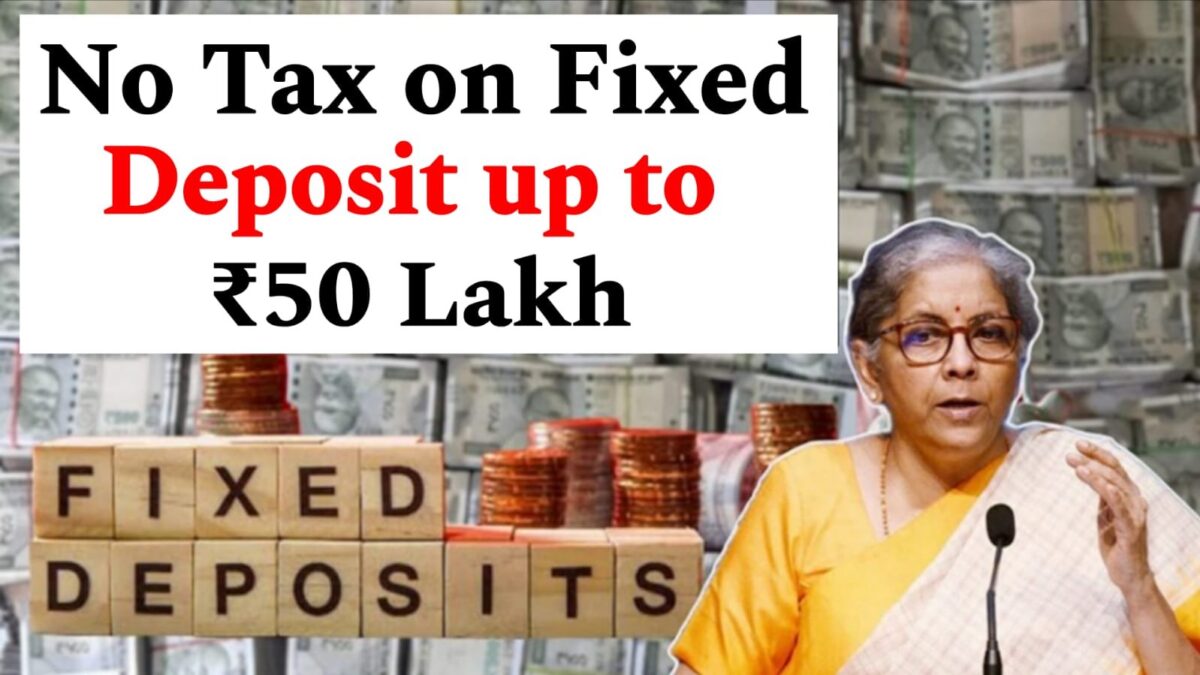
Investing in fixed deposits (FDs) in India is popular among many due to its safety and attractive returns. While FDs are traditionally seen as a secure investment option, many investors are concerned about the taxes imposed on the income earned from these deposits. Fortunately, recent updates provide potential relief for investors. Let’s explore the details surrounding income tax on FDs and the exemption available for certain amounts.


Income Tax on Fixed Deposits: No Tax on Investments up to ₹50 Lakh
A significant number of individuals put their money into fixed deposits, expecting substantial returns. However, they often face the challenge of paying taxes on the interest earned. Fortunately, there is good news:
– If your total investment in fixed deposits does not exceed ₹50 lakh, you can avoid paying tax on the interest income, provided that:
– Your entire income solely comes from FD interest.
– Your total annual interest income is less than ₹4,00,000.


This means you may not need to file an income tax return (ITR) if you meet these criteria.
How Will You Get Tax Exemption?
Under the new tax regime, the government has declared that income up to ₹4,00,000 is tax-free. In simple terms, if your total income is derived strictly from bank interest and remains below ₹4 lakh, you will not be required to pay any income tax.
Understand with an Example
To better clarify this, let’s consider an example:
– If you invest ₹50 lakh in an FD scheme with a 7.75% interest rate, your annual interest income would be:
– ₹3,87,500
Since this figure is less than ₹4,00,000, you will not incur any tax on this income.
How to Avoid TDS Deduction?
A common concern among investors is how to mitigate TDS (Tax Deducted at Source) on their FD earnings. Banks are required to deduct TDS according to government regulations. However, if your total income originates solely from FD interest and is below ₹4,00,000, you can take measures to ensure TDS is not deducted.
What Do You Need to Do to Avoid TDS?
– Senior Citizens (aged 60 and above) should submit Form 15H.
– Individuals under 60 years need to provide Form 15G.
These forms should be submitted to your bank annually before April 1st, ensuring that TDS is not deducted from your FD interest.
What Are the New TDS Rules?
Recent changes by the government have raised the TDS limit, which is advantageous for both senior citizens and general investors:
– For individuals under 60, TDS is deducted only if interest income exceeds ₹50,000 in a year.
– For senior citizens, TDS is deducted when interest income exceeds ₹1,00,000 in a year.
These adjustments aim to provide relief to taxpayers and ensure that they retain more of their hard-earned money.
In conclusion, understanding the tax implications on fixed deposits can significantly benefit investors. With the current provisions in place, there is an opportunity for many to enjoy tax relief when making FD investments, as long as they remain aware of the income limits and necessary paperwork.
What is the tax exemption limit on fixed deposits?
How can I avoid TDS on FD interest?
What forms are required to avoid TDS deduction?
What is the new TDS rule for senior citizens?
Is income from fixed deposits taxable?
