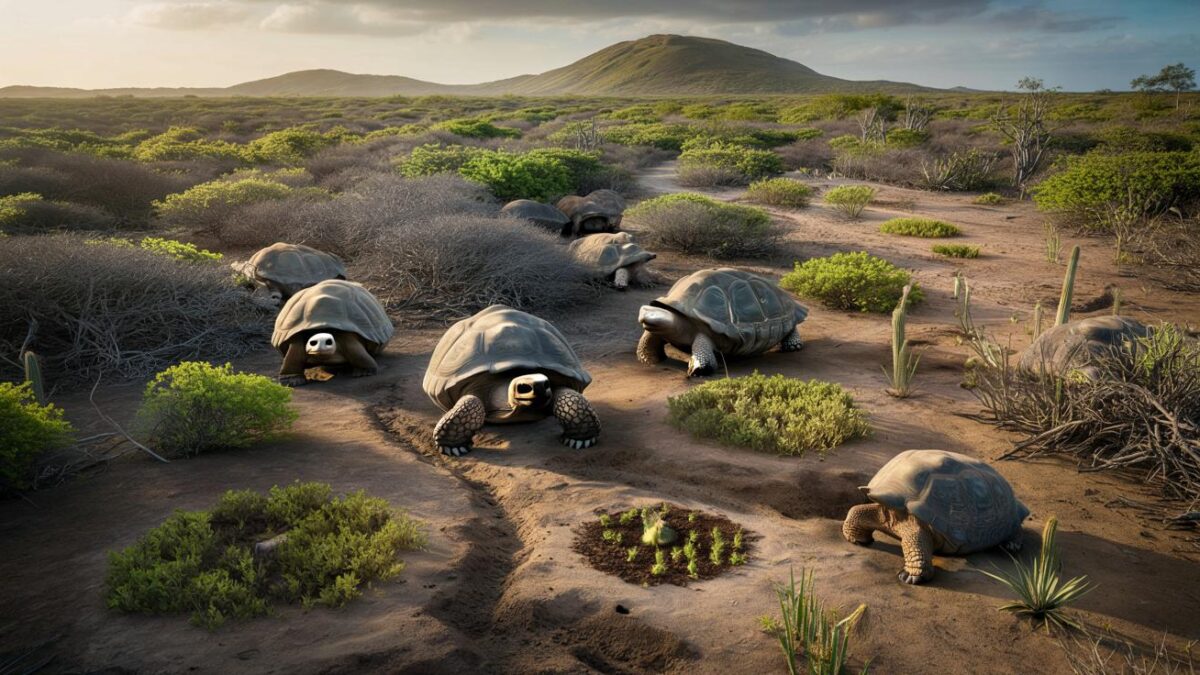
The Galápagos archipelago, long treated as a museum of evolution, now doubles as a test site for rebuilding damaged ecosystems with living animals instead of concrete and steel. This archipelago, famous for the research that shaped our understanding of evolution, is now pioneering a new kind of science: ecological restoration through the return of its largest native herbivore. The idea is simple yet profound: rather than relying on human intervention to pull invasive plants or rebuild soil, managers are unleashing a biological force that has shaped these islands for millions of years. The giant tortoise is back, and the landscape is responding faster than many experts predicted.


The shift is happening right now on the ground and in the air. Aerial imagery shows canopy gaps opening where once-dense thickets stood. Botanists are spotting native seedlings in places that had gone quiet for generations. Even the soundscape is changing, with finches and other birds returning to feed and nest in newly opened patches. It is a living lesson in how history, biology, and conservation policy can converge to fix problems that seemed permanent only a few decades ago.
How the giants disappeared from their own islands


When Charles Darwin walked across Galápagos in 1835, giant tortoises shaped almost everything he saw. They browsed shrubs, trampled paths, fertilised the soil and moved seeds between distant patches of vegetation. Sailors soon treated them as moving barrels of meat. By the mid‑20th century, hunting, egg collection and introduced goats and pigs had wiped out most populations. The combination of human exploitation and invasive species created a one-two punch that tortoises could not survive. Goats and pigs ate the same plants tortoises relied on, while pigs dug up nests and ate eggs, ensuring few young survived even when adults were left alone.
On some islands, not a single tortoise survived. What looked like a local extinction of one species triggered a slow transformation of the entire landscape. Without big herbivores, woody plants thickened. Invasive shrubs took over open ground. Seed dispersal collapsed, especially for trees and cacti that relied on large animals to carry their fruits. In the absence of disturbance, the vegetation structure shifted from a dynamic mosaic to a closed, uniform thicket. This shift may look like “natural” regrowth to an untrained eye, but it was actually the result of a broken ecological engine.
For roughly 150 years, key ecological processes in Galápagos ran on half power, because their main herbivore had vanished. The tortoise had been the keystone engineer, the species that literally carved the environment into a shape that benefited many others. Without it, nutrient cycling slowed, seeds piled up under parent plants instead of traveling, and the balance between shrubs and herbs tipped in favor of the shrubs. The islands still looked wild to visitors, but their inner workings had shifted.
Researchers later pieced together what happened: soils held more leaf litter, fires changed behaviour, and young native plants struggled to find light in dense thickets. It became clear that simply removing goats and pigs was not enough. The system needed a “spark” to restart the processes that keep the landscape diverse and resilient. That spark, it turned out, had four legs, a thick shell, and a slow but steady appetite.
Mass reintroduction: building a living restoration team
From the 1990s to 2020, the Galápagos National Park and Galapagos Conservancy launched one of the most ambitious reptile recovery efforts on record. Breeding centres raised hatchlings from the few surviving adults and from hybrids recovered on remote islands and in captivity. This careful breeding work was not just about increasing numbers; it was about restoring genetic diversity and making sure the right types of tortoises ended up on the right islands. Conservation teams ferried young tortoises by boat and helicopter to Española, Santa Fé, Pinzón, parts of Santa Cruz and other carefully chosen sites. The logistics were complex: cold-chain transport, health checks, acclimation, and soft-release strategies to give the animals the best start.
In total, more than 1,500 giant tortoises went back into the wild. That headline number matters, but the real story sits in what they started to do after release. Instead of acting as rare relics, the animals resumed their old role as ecosystem engineers. In some locations, managers used temporary fences to keep the animals in target areas at first. In others, they released animals directly into landscapes that were ready for change. The strategy was adaptable: tailor the release to the habitat, monitor closely, and adjust based on the response. The results have validated the approach.
How tortoises knock back invasive shrubs
Giant tortoises work like slow, low bulldozers. They chew through low vegetation, push through thickets and repeatedly step on young shrubs. Each movement changes the shape of the plant community around them. Their feeding is not picky but effective: they graze down a wide range of plants, including many invasives that have come to dominate the understory. Over time, this grazing pressure reduces the dominance of woody plants and creates pockets of open ground where light hits the soil again.
- They cut down dominance of invasive shrubs, especially in former goat‑grazed areas.
- They stop dense thickets from closing every gap in the landscape.
- They keep open corridors that small birds, lizards and other reptiles use for movement and feeding.
On Española, where aggressive shrubs and introduced grasses had crowded out native plants, the return of tortoises reversed a trend that had stood for decades. Drone images and vegetation plots now show a patchier, more open mosaic, closer to the structure described in 19th century ship logs and naturalists’ notes. Where managers once spent money and labor clearing brush by hand, tortoises now do the work for free, day after day. The savings in maintenance costs are real, but the gains in ecological function are even more important.
By simply eating and walking, tortoises are doing the sort of vegetation management that would otherwise demand costly human crews and heavy machinery. As a side effect, their trails become micro-highways for other species. Lizards bask on warm stones along these paths, finches sift through disturbed soil for seeds, and ground-nesting bees dig into bare patches created by tortoise feet. It is a cascade of small benefits that adds up to a healthier ecosystem.
Ecologists compare their role to elephants in African savannas, which break saplings and keep woodlands from swallowing grasslands. Galápagos never had elephants, so the tortoise fills that niche at a smaller but still powerful scale. In this sense, the tortoise is a right-sized ecological proxy for functions that are missing in many island systems. The comparison is not just poetic; it guides expectations about how the vegetation should respond and helps managers set targets for habitat structure and biodiversity.
Seed dispersers that carry forests in their guts
Giant tortoises also act as cargo ships for seeds. They swallow fleshy fruits whole, grind some plant tissue and send intact seeds on a long, slow journey through their gut. That journey matters because it moves genes and helps plants colonise new patches of suitable habitat. The “gut passage” effect has been documented in many fruit-eating animals, but giant tortoises are uniquely suited to islands: they travel far enough to bridge gaps between habitats, and they live long enough to keep doing it for decades.
- Field studies show tortoises can carry seeds 3–5 kilometres from the parent plant.
- Seeds leave the gut packed in nutrient‑rich dung, which boosts germination.
- Droppings land in open spots and along tortoise trails, where light and space favour seedlings.
Species that benefit include native cacti such as Opuntia, trees like Piscidia carthagenensis and the iconic daisy‑tree group Scalesia. In parts of Santa Cruz, seedlings of these plants appear again in places where botanists had not recorded them for years. Soil samples and seedling surveys indicate that the dispersal network, once broken, now runs again along the paths used by reintroduced tortoises. Researchers are also seeing that seed survival improves when seeds are delivered in dung: the nutrient boost and the protection from desiccation give many seeds a better start than if they simply fell under the parent tree. In other words, tortoises do not just move seeds; they prepare them for success.
Tortoises as full‑scale ecosystem engineers
When you stack herbivory, trampling, digging and seed transport, the effect reaches far beyond single plants. Ecologists now describe Galápagos tortoises as ecosystem engineers, in the same category as beavers that build dams or woodpeckers that create cavities for many other species. The key point is that they change the physical environment in ways that benefit a wide range of organisms. Their “engineering” is not planned or intentional; it is the natural byproduct of being large herbivores in a world of plants, soil, and other animals.
- They reshape plant structure, turning wall‑like thickets into a mix of clearings and clumps.
- They create small depressions and bare patches that act as micro‑habitats for invertebrates and ground‑nesting birds.
- They expose soil, increasing sunlight and temperature at ground level, which favours fast‑growing native herbs.
- They reduce the competitive edge of slow, shade‑tolerant invasive plants.
Over time, aerial surveys record a shift from monotone brush to a varied patchwork of open ground, low herbs and taller shrubs. This structural diversity benefits seed‑eating finches, insect‑hunting flycatchers and several endemic reptiles that prefer mixed cover rather than uniform scrub. Even soil organisms respond: beetles and dung decomposers become more abundant around tortoise trails, accelerating nutrient turnover. By stitching these small changes together, tortoises create a landscape that is more resilient to disturbance and better able to support the full web of native life.
What changed: before and after the comeback
To measure the impact of reintroduction, scientists track multiple indicators, from plant cover to bird counts. A simplified snapshot looks like this:
Indicator
With few or no tortoises
After large‑scale reintroduction
Shrub cover
High, continuous thickets
Reduced, more gaps and edges
Native plant regeneration
Minimal outside remnant patches
Regular seedlings across broader areas
Seed dispersal
Short‑range, mostly by small birds
Long‑range, tortoise‑driven transport
Bird diversity in open habitats
Stalled or declining
Rising where new clearings form
The data point to a clear pattern: the system did not heal just by being left alone. Recovery started when the right herbivore returned. Importantly, these changes are not just aesthetic; they reflect a measurable recovery of ecological processes that had stalled for generations. Soil turnover, nutrient cycling, and seed movement are all ticking upward, creating a foundation for more complex food webs and greater genetic mixing among plants.
Why this rewilding project stands out
Conservation science has watched Galápagos closely because the project goes beyond saving a charismatic animal. It works at four different levels at once. First, it targets function, not just form: the goal is to restore processes, not just paint a landscape green. Second, it embraces scale: animals are moving across large areas and interacting with diverse habitats. Third, it accepts time: managers plan in decades, not fiscal years. Fourth, it integrates science and practice: every release is a field experiment with rigorous monitoring.
- Scale of action: more than 1,500 animals, from several lineages, moved across multiple islands instead of one fenced reserve.
- Timeframe: a response to a collapse that had lasted roughly a century and a half.
- Ecological depth: focus on processes such as nutrient cycling, seed dispersal and vegetation structure, not just head counts.
- Scientific value: a real‑world test of “rewilding”, where restoring functions matters as much as restoring species lists.
The case now feeds into debates from Europe’s bison projects to North American plans for beavers and large herbivores. It offers empirical backing for an idea that often sounded theoretical: reintroducing the right animal can flip a whole system into a different, more resilient state. In a world where many ecosystems are stuck in degraded states, Galápagos shows how a well-chosen species can push the system past a tipping point and into a healthier equilibrium. Managers and policymakers can use this experience to design projects that are realistic, scientifically sound, and socially acceptable.
Living infrastructure instead of concrete solutions
Many environmental policies lean heavily on engineered fixes: desalination plants, seawalls, artificial wetlands. Galápagos suggests a complementary path. When tortoises take over, they run on sunlight and plants, not diesel or grid power. They are self-replicating, self-maintaining, and they do not break down. They also provide a suite of services—vegetation control, seed dispersal, nutrient mixing—that would otherwise require multiple separate projects.
- They need no imported fuel or spare parts.
- They work every day, at low speed but high persistence.
- They can live for more than a century, bridging human political cycles.
In that sense, giant tortoises act as living infrastructure. Managers still need fences, patrols and monitoring, but the heavy lifting in the field shifts from machines to metabolism. Similar thinking now drives projects with beavers in river catchments, bison on restored prairies, elephants in savanna mosaics and even camels in some dryland trials. The concept is simple: invest in biology that produces public goods, and you get a resilient system that repairs itself. That is a powerful alternative to the “build and replace” cycle of concrete-heavy environmental engineering.
Risks, limits and what comes next
The Galápagos story does not remove all worries. Climate change alters rainfall, sea temperatures and storm patterns around the islands. Invasive species, from rats to aggressive plants, still reach remote bays through cargo and tourism. Young tortoises face predation and disease, so teams continue to guard nests and head‑start hatchlings in breeding centres. These are not small challenges; they require steady funding, political will, and adaptive management. But they are manageable with the right tools.
Managers also need to keep a close eye on numbers. Too many tortoises on one island could strip vegetation faster than it recovers, especially under drought. Ongoing research tests how many individuals each habitat can support while still delivering the positive engineering effects seen so far. This is classic ecosystem management: find the sweet spot where the herbivore keeps the system open without overdoing it. The lessons are already guiding plans for new releases and for fine-tuning the mix of tortoise lineages on each island.
For readers watching from outside Galápagos, the key lesson sits in the method rather than the species. Any region that has lost a dominant herbivore or “ecosystem engineer” can ask a set of concrete questions: Which functions vanished with that animal? Can another species, or a carefully managed reintroduction, bring those functions back? What social conflicts might arise when large animals return to working landscapes? Galápagos offers a rare, data‑rich case where those questions meet real outcomes: more native plants, more structural variety, and ecological processes that no longer sit frozen in time. The giant tortoise, long treated as a symbol of slowness, now shows how quickly a system can shift once the right piece returns to the board.
How do giant tortoises help control invasive plants in Galápagos?
Do tortoises really spread seeds far from parent plants?
Which islands have received reintroduced tortoises?
Can too many tortoises harm the habitat?
What is the long-term outlook for this project?
