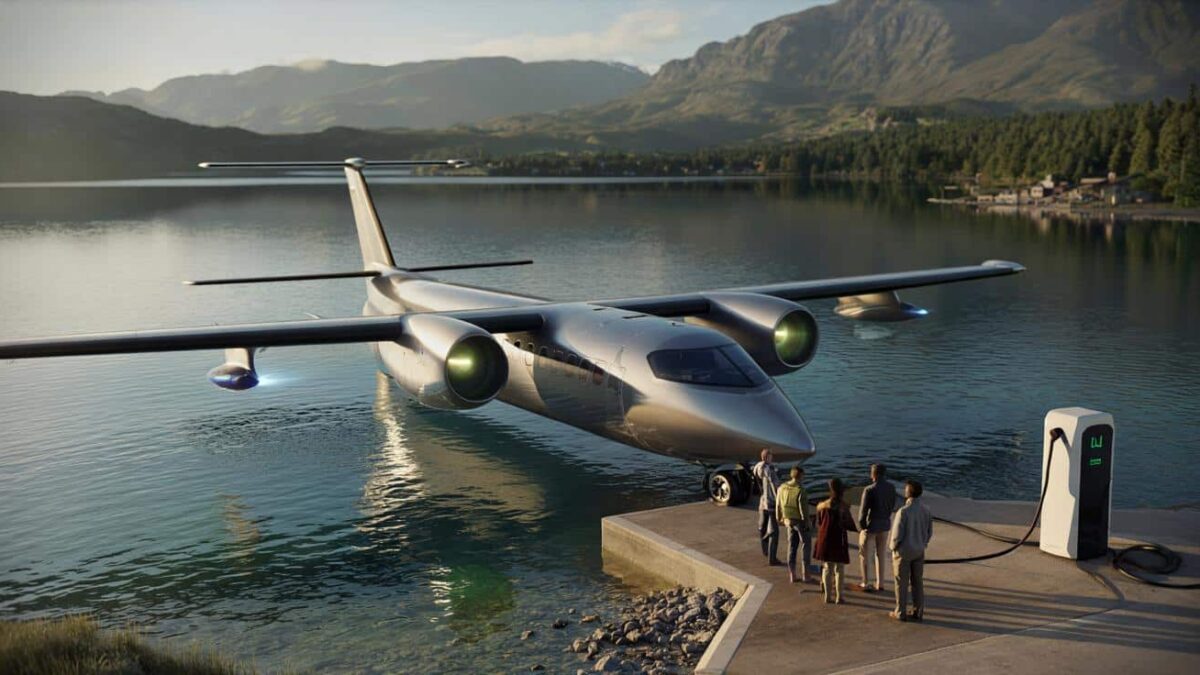
Can a small regional aircraft really change how we think about flying? A young French company thinks so, with a design that bends almost every rule of conventional aviation.


Instead of chasing record-breaking speed or luxury cabins, Eenuee wants to reinvent the short-haul plane from the ground up. Their goal is a fully electric aircraft that sips energy, takes off from lakes as easily as from runways, and aims to slash emissions on routes where trains still struggle to compete.
The quiet revolution in regional skies
Aviation faces growing pressure as governments tighten climate targets and travellers question the impact of short flights. Long-haul jets get most of the headlines, yet a large chunk of emissions comes from frequent regional hops of a few hundred kilometres, where alternatives remain patchy or slow.


For those routes, the French startup Eenuee proposes something radical: a 100% electric regional aircraft called Gen-ee, designed for 19 passengers, a range of around 500 kilometres, and energy consumption claimed to be 11 times lower than current regional planes.
Gen-ee targets a 500 km all‑electric range for 19 passengers, with a take-off weight of just 5.6 tonnes — and 11x better energy efficiency than today’s regional aircraft.
Founded in 2019 in Saint-Étienne, Eenuee does not try to electrify a classic tube-and-wing airframe. Instead, it bets on a blended wing body configuration with a “lifting fuselage”, advanced composites and a simple, non-pressurised structure. The company recently struck a strategic partnership with Duqueine Group, a major composites specialist, to accelerate development toward a first flight in 2029.
Why regional electric aviation matters
Emissions from aviation continue to rise, despite better engines and sustainable aviation fuel. Many countries have improved rail networks, yet rail cannot solve everything, especially in remote, mountainous or sparsely populated regions where tracks would cost billions.
Local authorities often face a harsh choice: subsidise unprofitable air routes with conventional aircraft, or let isolated regions fall further behind. Short-runways, scattered islands, harsh winters or high relief make rail unrealistic in places from the French Alps to northern Canada.
Electric regional aircraft appeal to communities that need connectivity, but cannot pay for heavy infrastructure or the fuel bills of traditional planes.
Eenuee wants Gen-ee to serve exactly these thin routes, using existing small airports and, in some versions, bodies of water as makeshift runways. The concept aims to cut operating costs and emissions at the same time, instead of asking local governments to trade one for the other.
➡️ Chef Etchebest reveals his mushroom cooking method that locks in juices for a caramelised finish
➡️ By diverting entire rivers for over a decade, the Netherlands has quietly reshaped its coastline and reclaimed vast stretches of land from the sea
➡️ How a single bedroom houseplant can increase deep sleep phases by 37%, according to a new nasa study
➡️ US aviation authorities investigate why a commercial flight returned shortly after takeoff without weather issues
➡️ They Are Under 60 And Already Living With Alzheimer’s
➡️ “I kept turning up the heating but still felt cold”: experts explain this common home mystery
➡️ US Social Security rules may change again here is what future retirees should pay attention to
➡️ Over 2 Million Wetland Plants Reintroduced In Flood Zones Are Absorbing Excess Water, Filtering Pollution And Preventing Urban Disasters
Inside Gen-ee: the “impossible” energy numbers
A blended wing body for less drag
The core of the project rests on aerodynamics. Gen-ee uses a blended wing body (BWB) layout with a lifting fuselage. Seen from the side, the fuselage itself looks like part of the wing, with a smooth transition between cabin and wings and no big conventional tailplane.
This shape, already studied for military aircraft and long-haul concepts, offers a sharp reduction in drag. Eenuee targets an aerodynamic efficiency, or glide ratio, of 25, which beats most existing regional aircraft. Less drag means less energy needed to maintain cruise.
The price to pay comes in handling and design complexity. Without a classic tail, Gen-ee relies on “elevons” — control surfaces that combine the role of elevator and aileron — to manage pitch and roll. This demands careful control laws, detailed risk analysis and many flight simulations before the first pilot ever takes off.
Electric propulsion with minimal losses
The second lever lies in propulsion. Turboprops burn fuel and lose a huge fraction of that energy as heat. Electric motors, by contrast, can reach around 90% efficiency from battery to propeller shaft.
By removing combustion, exhaust and complex gearboxes, Gen-ee trades battery packs for fuel tanks and aims for a far simpler mechanical chain. Electric propulsion also reduces noise, which matters for small airports close to villages or lakeside communities.
Weight savings from materials and design
The third pillar is mass reduction. Eenuee plans a maximum take-off weight of 5.6 tonnes under EASA CS-23 rules, where similar aircraft can go up to 8.6 tonnes. That gap comes from three factors:
- widespread use of carbon fibre composites for the fuselage and main structure
- careful use of high-performance aluminium where composites are less practical
- a non‑pressurised cabin, which lets the structure stay lighter and simpler
Each kilogram saved avoids emissions over the aircraft’s lifetime and helps extend range. A lighter airframe means smaller motors and smaller batteries for the same mission, which cuts cost and improves reliability.
Weight, drag and drivetrain losses have been attacked together. That system-level approach underpins the claim of 11x better energy efficiency than conventional regional aircraft.
From lakes to remote strips: a multi-surface machine
Gen-ee does not stop at runways. Eenuee develops a version that uses hydrofoils — submerged wings under the fuselage — to take off and land from water.
At speed, the hydrofoils lift the fuselage above the water, slashing drag in the same way a high‑speed racing boat rises on its foils. Once the aircraft gains enough speed, it can rotate and climb, following a profile similar to a runway departure.
This approach differs from classic floatplanes. Traditional seaplanes sit on bulky pontoons that create drag and demand specialised maintenance. In contrast, Eenuee wants a “multisurface” aircraft capable of operating from both water and conventional runways without reconfiguration.
Such flexibility could prove attractive in regions like:
Region
Specific need
How Gen-ee could help
Scandinavia
Coastal villages, fjords, lakes
Water take-off and landing where airstrips are scarce
Canada & Alaska
Remote communities, seasonal ice, long distances
Year‑round access using lakes and short gravel strips
Southeast Asia
Island chains and river networks
Connections along rivers and between small islands
Certification, risk and the long road to 2029
No aircraft flies paying passengers in Europe without certification, and that path often kills ambitious concepts. Eenuee openly frames its strategy around “de‑risking” step by step rather than chasing a flashy first flight at all costs.
The roadmap combines numerical simulations, scaled demonstrators and iterative design. The team already tests a 1:7 scale model and plans a 1:4 demonstrator to address manufacturing, control behaviour and structural loads on something close to final size.
Each round informs the certification work under EASA CS-23, the regulation that covers small aircraft up to 8.6 tonnes. Risk analysis, structural tests, flight envelope definition and safety systems all feed into the future Design Organisation Approval (DOA), which Eenuee expects to launch around 2027.
Scaled prototypes let engineers spot aerodynamic quirks, control issues and structural hotspots early, when design changes are still affordable.
On the ground, infrastructure needs stay modest. Gen-ee should operate from existing aerodromes with basic terminal facilities and safety equipment. Charging solutions would mirror those used in the automotive sector or for ground support vehicles already present at many airports, rather than requiring bespoke hydrogen plants or new pipelines.
Beyond passengers: new roles for low-energy aircraft
Although Gen-ee’s first target is regional passenger transport, Eenuee does not limit the concept to a single market. The lifting fuselage and low operating cost could unlock other applications, where reliability and short-field performance matter more than cabin service.
Potential variants could serve:
- medical evacuation and air ambulance missions in remote areas
- humanitarian logistics for disaster zones cut off from roads
- light cargo and postal flights where volumes are small but frequent
- defence or surveillance roles over coastal or border regions
Electric propulsion offers an advantage in some of these roles: lower noise and reduced thermal signature compared with turbine-powered aircraft. That makes night operations less disruptive near villages and helps in sensitive environments such as national parks.
What this says about the next decade of flight
The Gen-ee concept touches on several wider trends in aviation and energy. First, it shows how regional aircraft may decarbonise faster than long-haul jets. Batteries still lack the energy density for intercontinental flights, yet for 200–500 km hops they start to look workable, especially when the airframe slashes drag and weight.
Second, it hints at a different way to think about “infrastructure”. Instead of waiting for new high‑speed rail tracks or new airports, some regions could make better use of lakes, small aerodromes and lightweight charging networks. That approach distributes investment rather than concentrating it in single mega-projects.
Finally, concepts like Gen-ee invite a more nuanced view of risk. Electric aircraft projects often stumble on overpromising or scaling too fast. Eenuee claims to move cautiously, expanding its team as R&D milestones are met and costs remain under control. The company still faces classic challenges: battery performance, certification timelines, financing cycles, and convincing operators to adopt a radically different airframe.
For travellers, the outcome could be subtle yet significant. The first electric regional flights may not feel futuristic: 19 seats, modest speeds, simple cabins. The deeper shift will sit under the skin — in the aerodynamics, weight, and energy flows that let a small plane serve remote communities with a fraction of today’s energy bill.
Natalie WrightNatalie’s work is marked by attentiveness to mood and personal reflection. She often writes about stillness, distance, and subtle emotional change. Her tone remains gentle and reflective, allowing space for ambiguity and individual interpretation.
How can a small electric plane be 11 times more efficient?
Can Gen-ee really take off from lakes?
What is the expected range and passenger capacity?
When will it enter service?
